Read more of the market.
Research across gamma positioning, volatility, price action, trend, and time of day. Different IRIS models use different combinations—not every input is active in every strategy.
Built by LEVEXES. Driven by market structure, machine learning, and relentless research. IRIS turns complex conditions into signals you can actually see—and keeps learning through ongoing testing and retraining. New in 9.3: a self-learning network check on every alert, on top of 9.2's VWAP/EMA confirmation and adaptive option holds. 9.3's alerts were right 30 minutes later 67% of the time. Backtested performance is not a guarantee of live results.

See what IRIS thinks at a glance. The line turns green after a BUY and red after a SELL. It dims when the alert's time runs out or price reaches support. Alerts scored 50 are 5-minute scalps, like this bounce after a fast drop.
Historical QQQ session from Sep 23, 2026, replayed with the current rules. The 5-minute alerts and the 9.3 filter were added later. Not a live recommendation.
Not every move gets the same clock. The SELL 73 is a main signal, so it stays active longer. The SELL 50 at the spike top is a 5-minute scalp, and its line dims after 5 minutes.
Historical QQQ session from Sep 28, 2026, replayed with the current rules. The SELL 73 hit its stop. One chosen session does not show overall performance.
Research you can inspect. The directional-signal option-buying study compares IRIS v9 with v8.5 under the same execution assumptions.
Simulated 1-contract ATM 0DTE options, 30-minute holds. Historical results—not live account returns.
Watch the structure change. Follow price through positive and negative gamma concentrations, with the latest exposure profile beside the session.
Recorded product capture. The screenshot's timestamps are historical, not a live feed.
Size shows where exposure gathers. Clean, outlined bubbles keep the price path visible while highlighting concentration across levels and time.
Recorded product capture. Exposure does not guarantee that a price level will hold.
More than a marker on a chart. Review entries, stops, targets, and outcomes alongside the reasoning behind each signal.
Historical product capture. Missed-move annotations use hindsight; they are not signals issued at the time.The Runway turns the dealers' book into a front page. Every minute it writes a headline and a summary from the data, keeps the king, the walls, the implied-volatility range and the day's targets on one chart, and parks a classic car at the latest price with the rest of the session ahead of it.
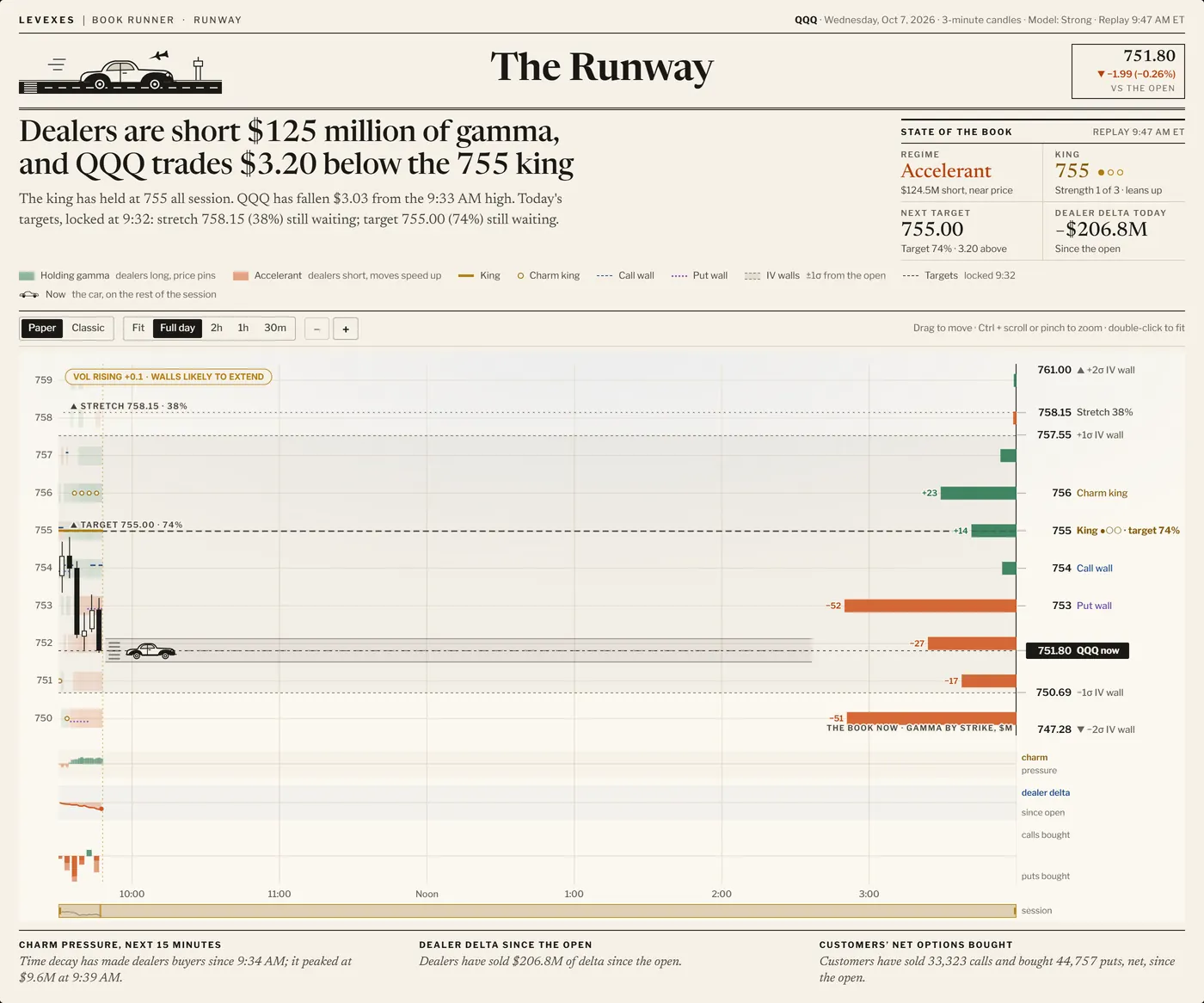
Watch the 60-second filmQQQ bottoms at 751.75. The paper marks it on the chart with a note: dealers had sold $206.8M of stock hedging by then.
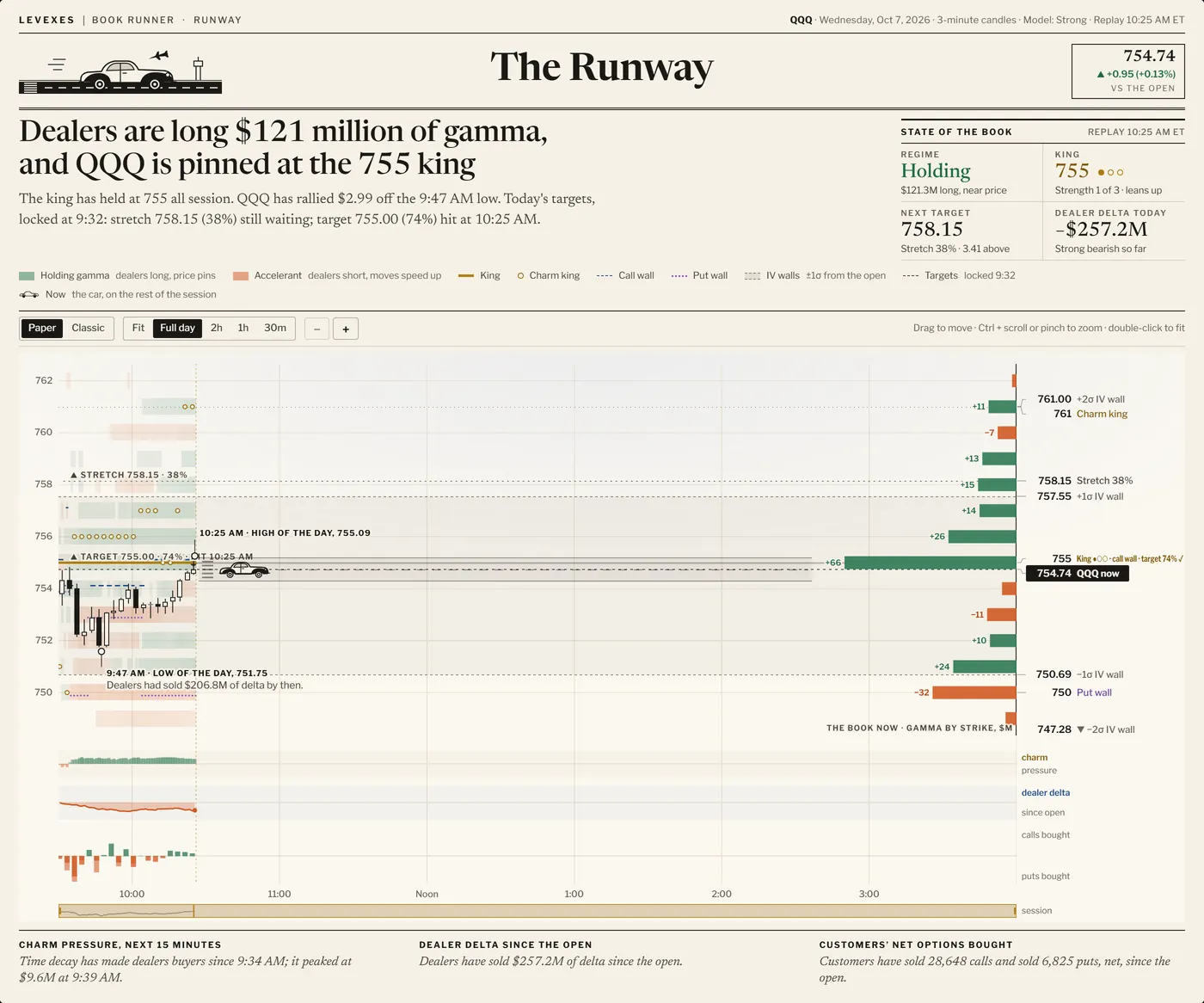
755.00, locked at 9:32 with 74% odds, is reached. The headline now reads: “Dealers are long $121 million of gamma, and QQQ is pinned at the 755 king.”
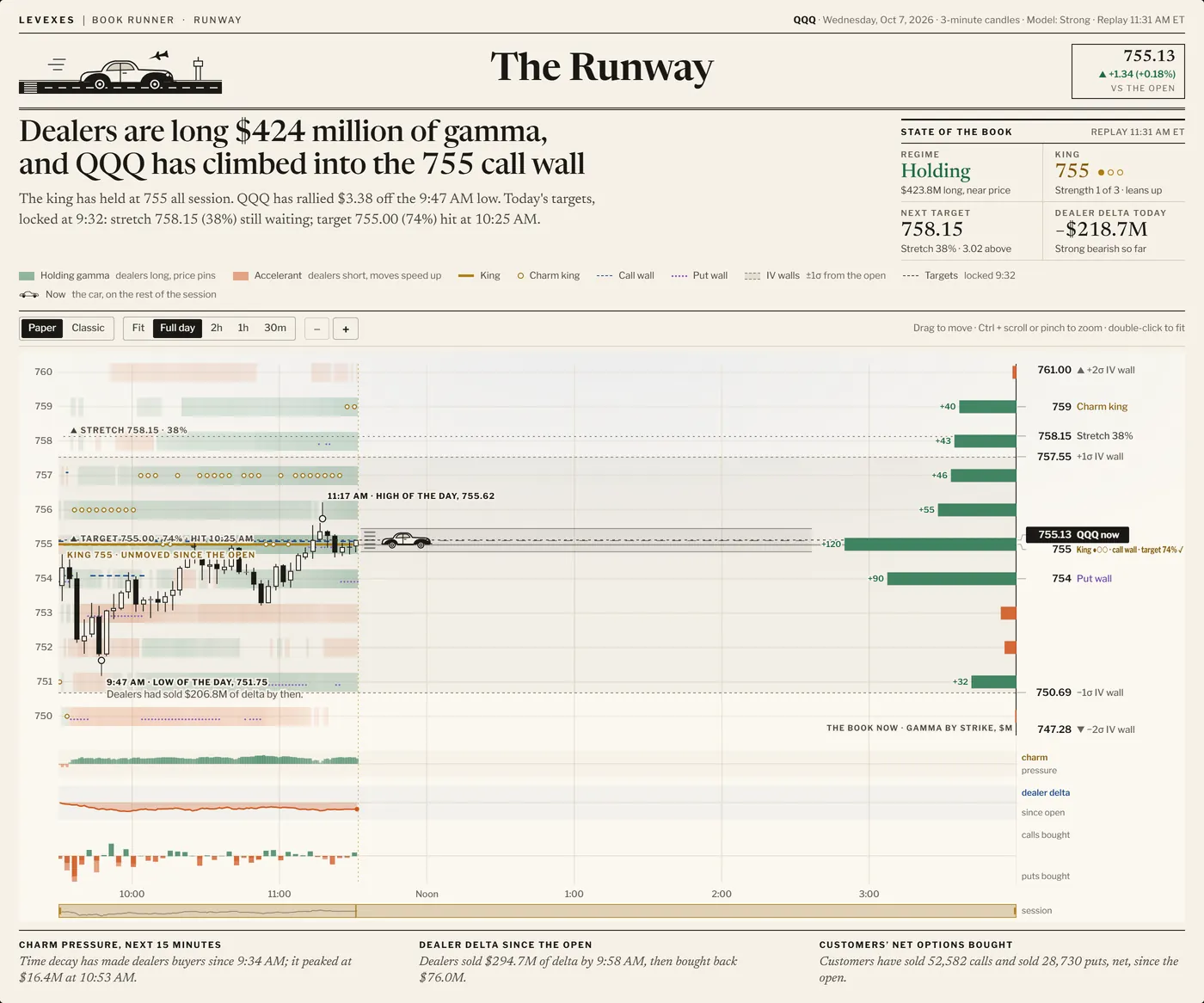
A close above 755, the strike where dealer hedging is biggest. “QQQ has climbed into the 755 call wall.”
The king moves to 757, right on the call wall, and price breaks through the +1σ implied-volatility wall at 757.55. The car sits at the price, with the runway ahead.
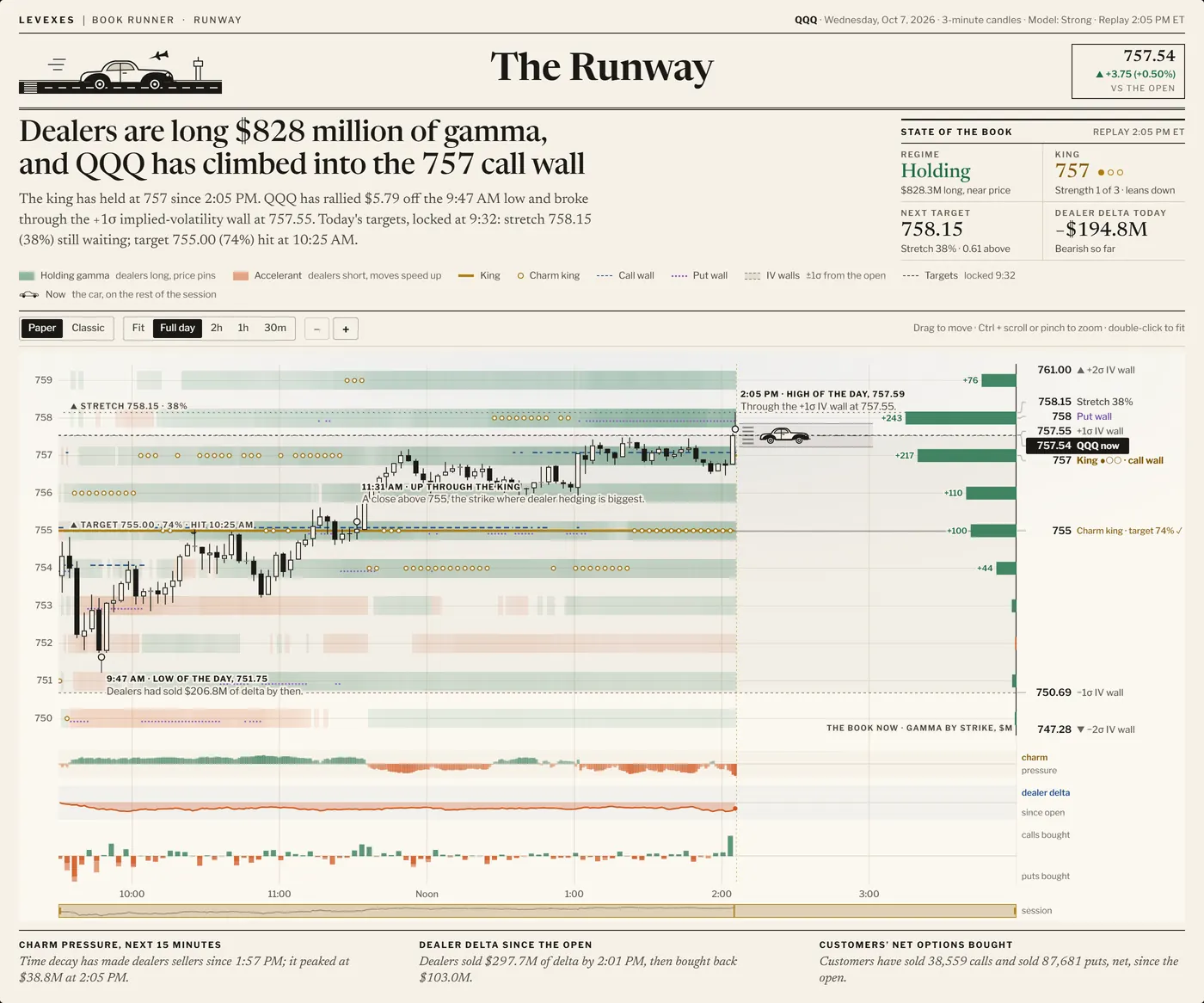
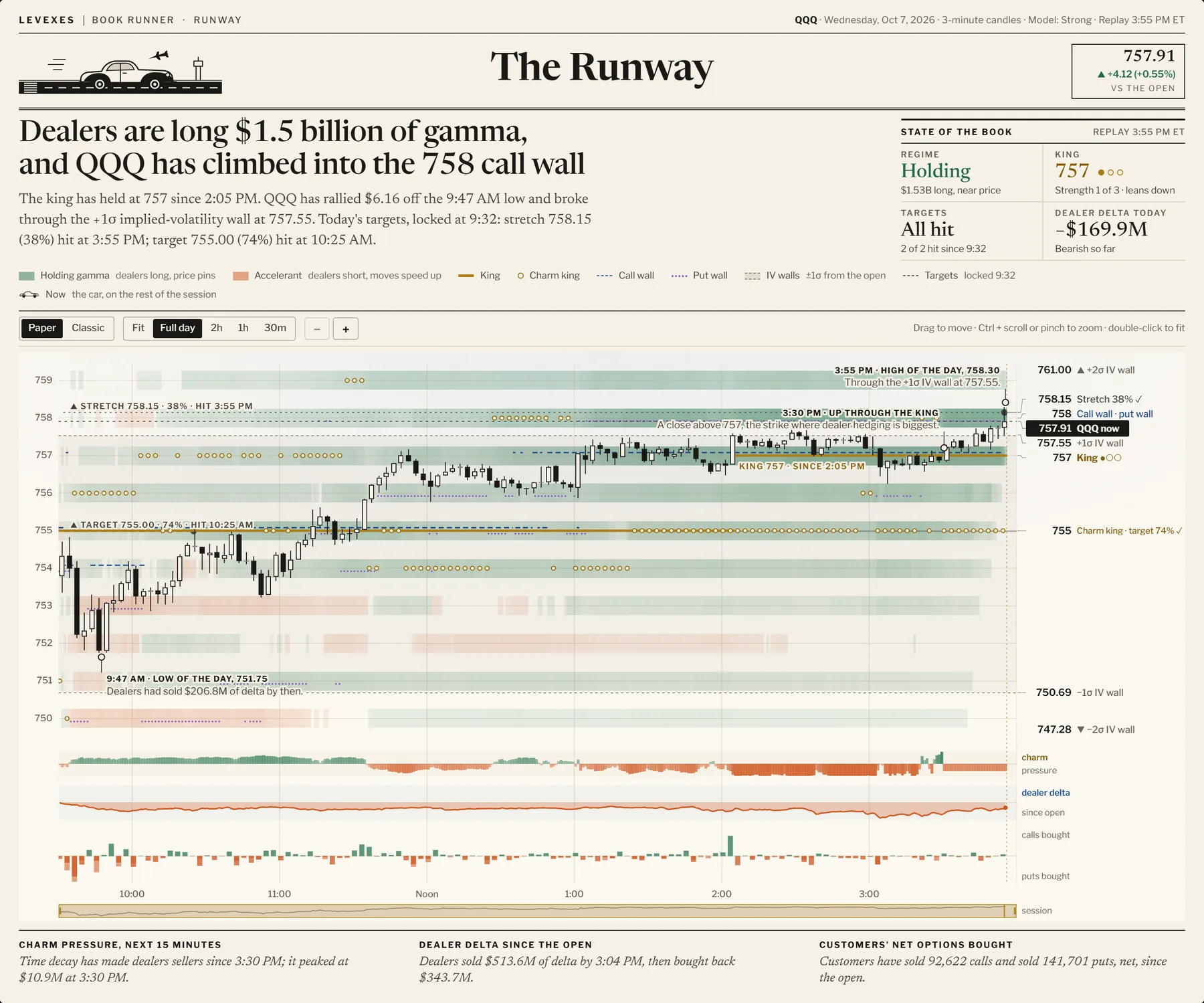
The 758.15 stretch target, 38% odds at the lock, is hit at the high of the day, 758.30. “Dealers are long $1.5 billion of gamma, and QQQ has climbed into the 758 call wall.”
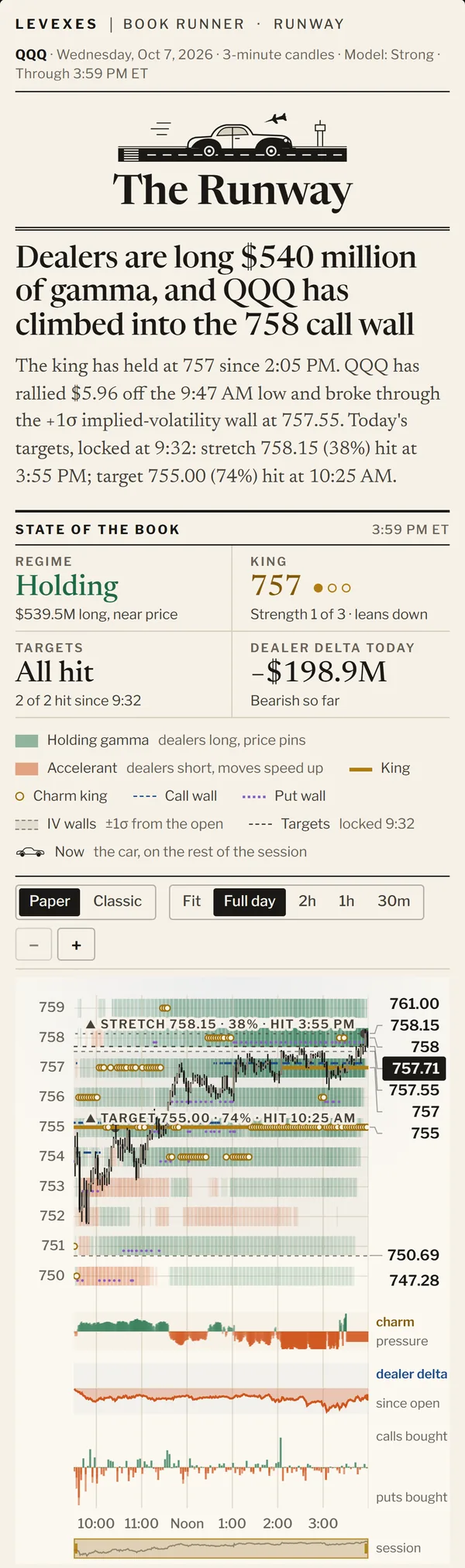
On Oct 7 every level Book Runner locked at the open was reached: QQQ's 755.00 target and 758.15 stretch, and SPY's 777.02 target and both stretches, 779.09 and 773.83. One day, not a promise: each level carries its own odds, and many days some are missed.
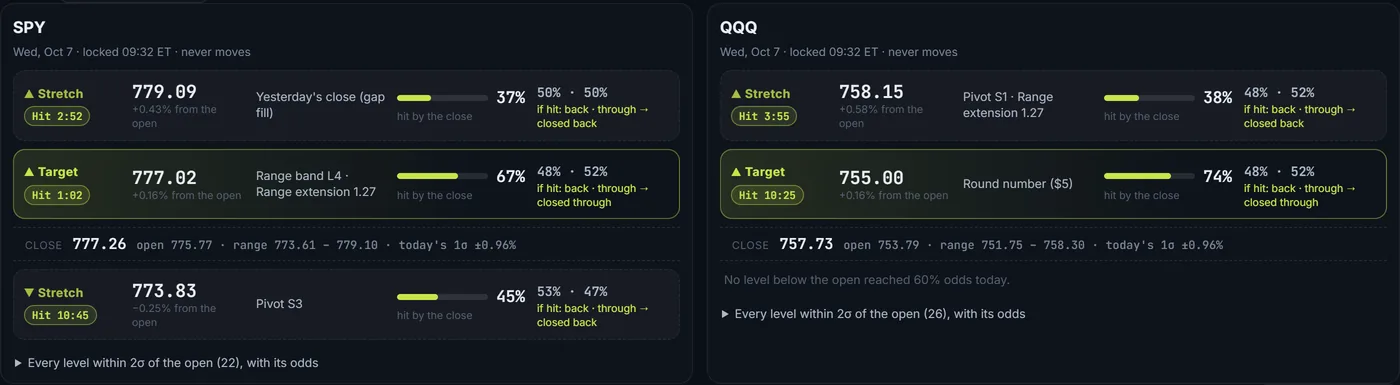
Real product captures from Book Runner's live book, Wednesday Oct 7, 2026. The live book is an estimate; each day is rebuilt from the full exchange tape after the close. Targets are odds set at 9:32 ET, not promises. Research, not advice.
IRIS 9.3 brings directional signals, model research, and option-selling strategies into the same workspace. Each has its own evidence.
Hypothetical results, not live account returns. Past performance does not guarantee future results; trading can lose money.
What was tested. IRIS 9.3's BUY and SELL alerts on SPY and QQQ. Each BUY buys one call 1 strike in the money; each SELL buys one put 1 strike in the money. Entry at the ask, exit at the bid after 30 minutes (60 when a trend is persistent and efficient), always before the close, with $0.35 fees per leg. This is option buying, not option selling.
Look at both sides. BUY alerts contributed +$4,746 across 264 trades; SELL alerts +$1,937 across 57 trades. "Right" means the price was on the alert's side 30 minutes after it fired: 67% in both 2025 and 2026.
What changed in 9.3. 9.3 keeps 9.2 and adds one check: an alert goes out only when a network that keeps learning from the market's 30-minute moves points the same way. It sends about a quarter fewer alerts than 9.2. The check was chosen on this same history, so this is not an untouched holdout, and 2026 is partial.
Source. IRIS 9.3 record, generated October 3, 2026. View the dated directional evidence ↗
Classic gamma maps start from open interest and assume dealers are long every call and short every put. Book Runner reads every option trade instead (who bought, who sold, signed by Book Runner Algo) and keeps the dealers' book strike by strike as the session moves.
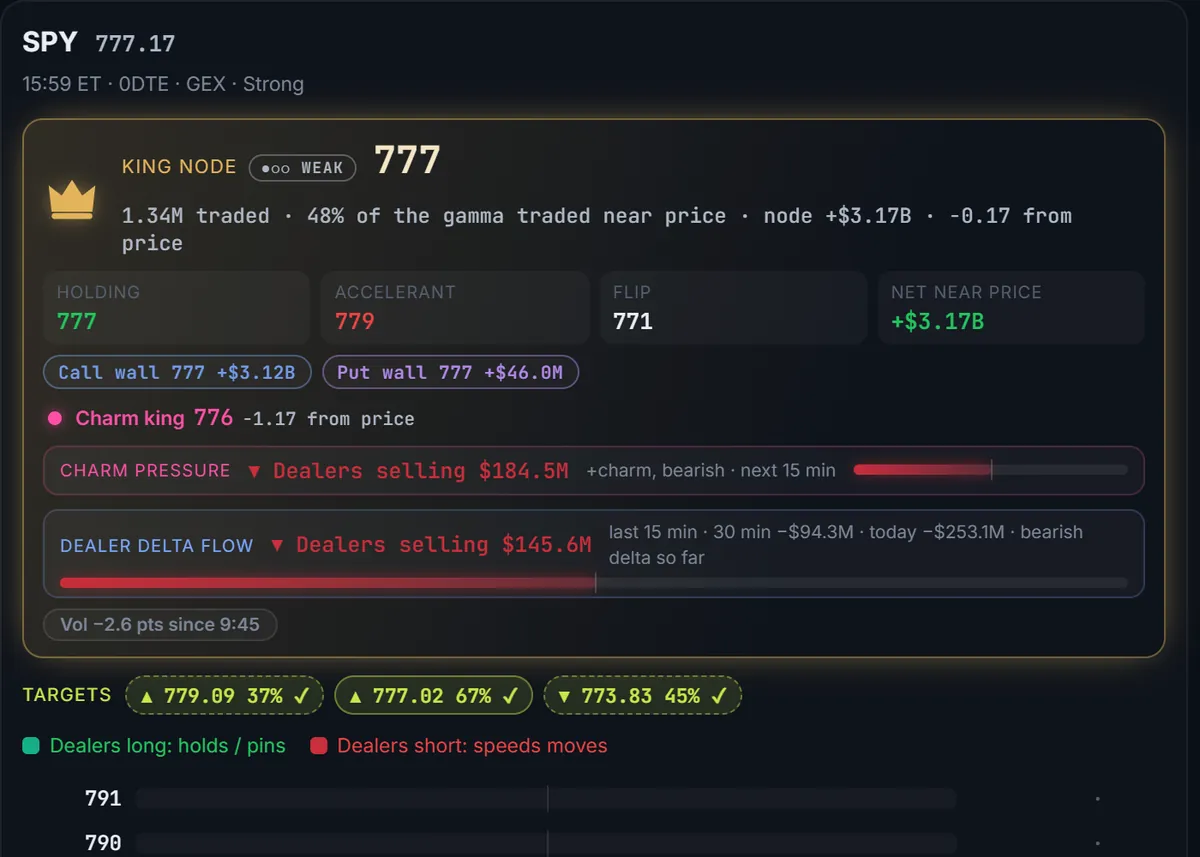
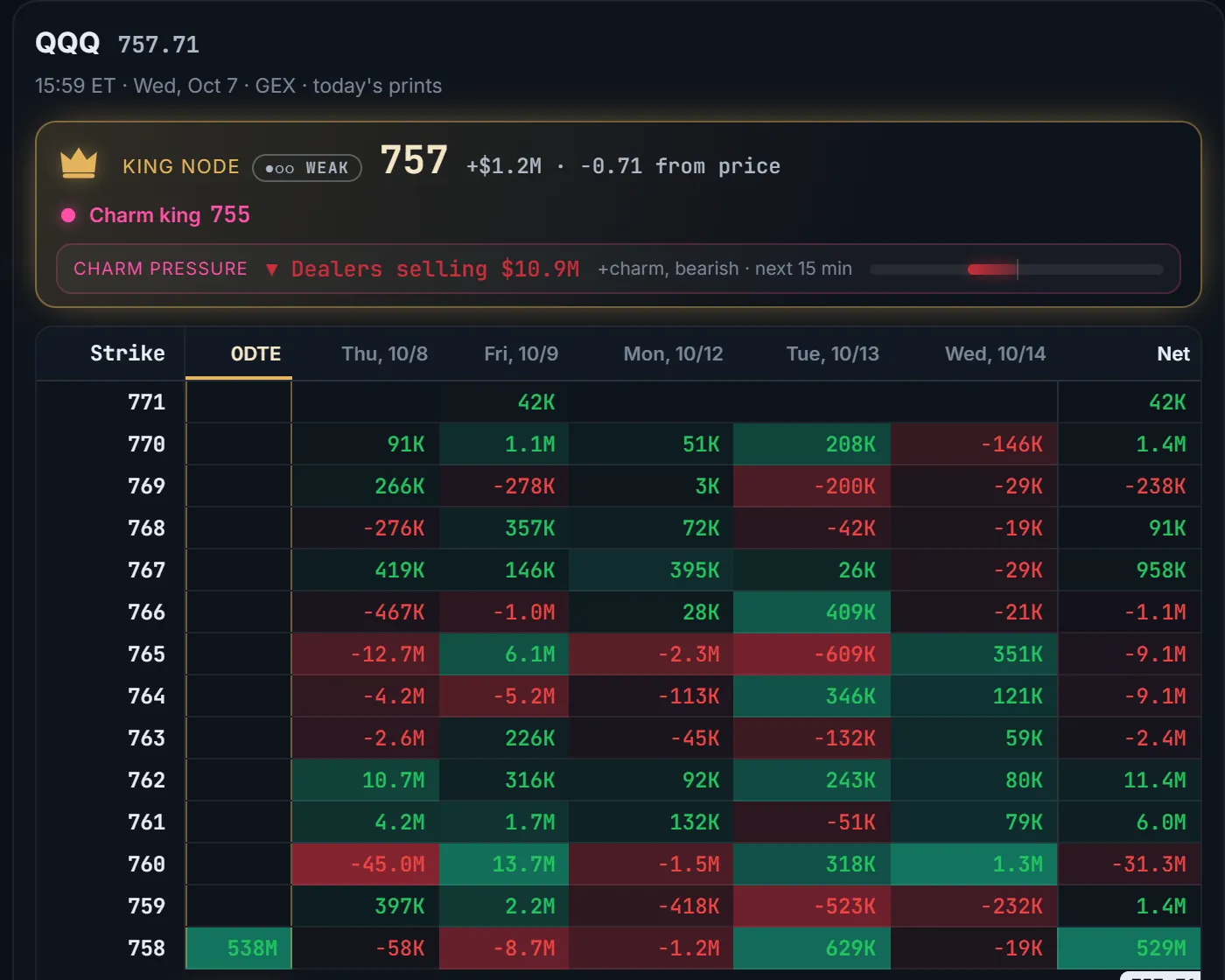
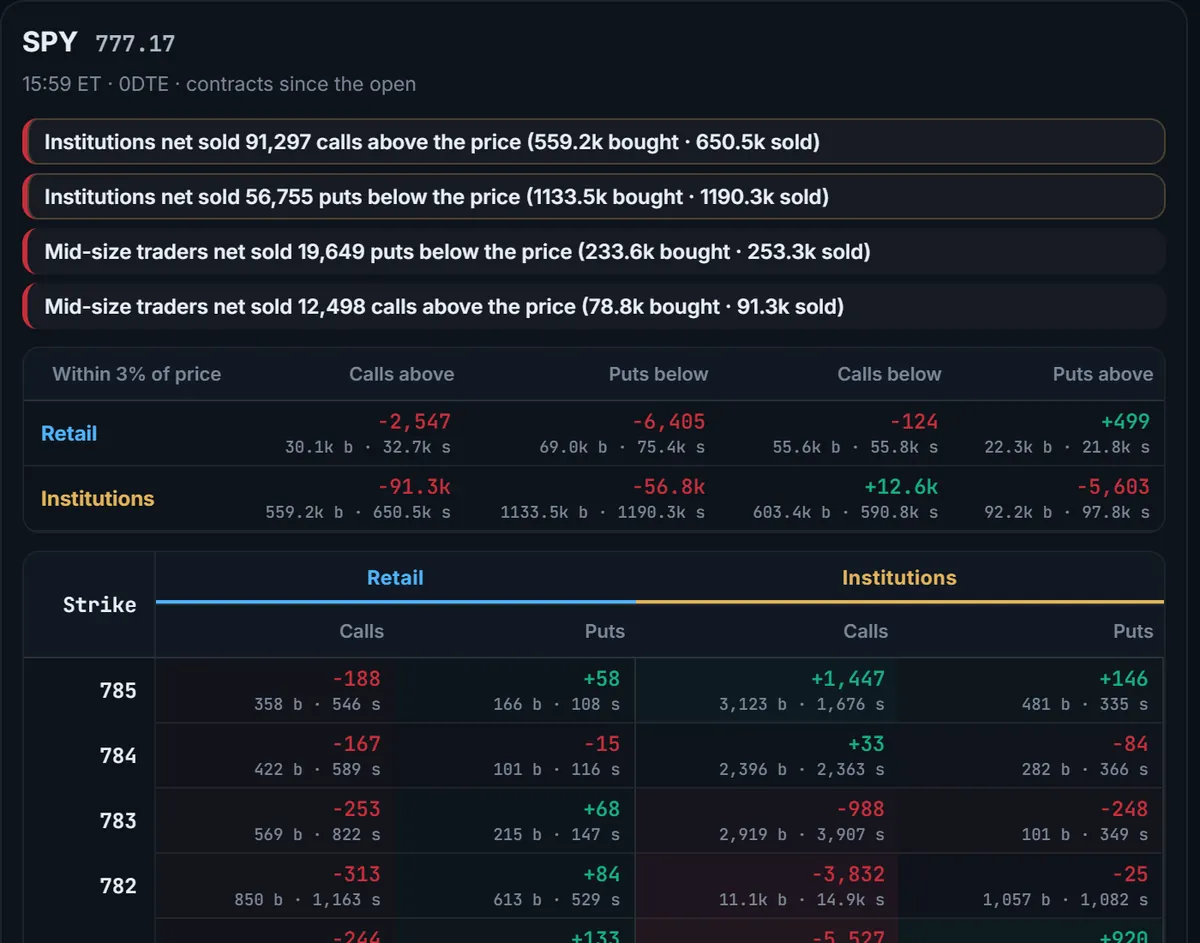
The dealers' side is inferred from public trade data: dealer identity and opening inventory are not observed. During the session the book runs live from the stream, so it is an estimate; after the close each day is rebuilt from the full exchange tape. Research, not advice. Trading can lose money.
One 0DTE credit spread a day on the side of the move, with the full record below.
Simulated results from historical data, not live account returns; the history includes development periods. Trading can lose money.
The rule. After 11:00 AM CT, the first time QQQ has moved far enough from its morning price (in units of the options market's own implied move), IRIS sells one credit spread on the side of the move: a put spread when QQQ is up, a call spread when it is down. QQQ spreads are $7 wide, SPY $5. Stop at twice the credit, otherwise out by 2:55 PM CT. One trade a day; FOMC and CPI days skipped; $0.35 per leg.
Sizing. The system doubles size after a VIX close of 18.72 or higher, about a quarter of days. Always one contract: +$6,004.
Limitations. The rule was found by research across these periods; it is not an untouched holdout. Spreads are priced from NBBO quotes (certified Cboe OPRA data). Fills matter: slippage and missed fills can reduce or remove simulated profits. View the dated evidence ↗
IRIS is our own evolving research system—not a single indicator with a new name.
Research across gamma positioning, volatility, price action, trend, and time of day. Different IRIS models use different combinations—not every input is active in every strategy.
Compare rules and models, measure risk-adjusted returns, and study the losses. Backtests and walk-forward studies help separate promising ideas from weak ones.
Store research, review outcomes, and retrain candidates over time. Learning happens through the research pipeline; deployed signals follow the currently released rules and models.
Continuous research is a process—not a promise that each update will outperform.
Go beyond a single indicator without losing sight of the chart.
Call walls, put walls, zero gamma and the King node from our new dealer model, read from every trade. Keep key levels close to price.
Retail against institutions, calls against puts, strike by strike since the open. Plus the IV smile, implied versus realized volatility, Vanna and Charm for a broader read.
Arrange your dashboard and bring the Gamma map, Book Runner, Market Breadth and Positioning into your workflow.
Our mission is simple: put better trading tools in more hands, so more people can trade with better information.
IRIS's BUY and SELL alerts, Book Runner's dealer levels and TENOR's trend reads as clean JSON, for your own charts, bots, alerts and spreadsheets.
Sign in with your approved Discord username and LEVEXES password.
Use this when your subscription email was approved directly. Discord members can use the Discord username form above.
Join the workspace and continue the conversation with the LEVEXES community.
Meet us on DiscordLEVEXES is free to join. Join our Discord community, and once your Discord username is approved, sign in here. The only paid add-on is the API, at $30.00 a month.
For $30.00 a month you get API keys for IRIS's alerts and Book Runner's dealer analytics: levels, whole sessions, who bought and who sold, and the daily targets, for SPY, QQQ and SPX. Subscribe on Ko-fi, send us your LEVEXES username on Discord, and create your key on the API page once access is on.
Enter your approved Discord username and choose a new LEVEXES password of at least eight characters. If your subscription email was approved directly, use “Activate membership” in the sign-in panel.
Yes. Arrange your chart panels and choose the ticker, exposure, and expiration controls available for each view. Build your layout around the markets you follow.
No. These are recorded product charts. Sign in for your workspace, where data timestamps and status indicators show the freshness of each view. Availability varies by market session and data source.
LEVEXES provides market analysis and research tools, not personalized investment advice. Levels, scenarios, and model signals are uncertain and can be wrong. Manage your own risk.
Research tools. Your decisions. Your risk.